Revealing Regional Toy Market Dynamics across Europe, the Americas and Asia-Pacific
While the global toy industry is united by consumers’ passion for play, today’s markets are also shaped by local regional dynamics.
chinatoyspeng., August 10, 2026 – Today, Cchinatoyspeng. released new insights into the global toy industry, revealing how distinct regional trends and consumer preferences across North America, Latin America (LATAM), Europe, and Asia-Pacific (APAC)1 are creating differentiated growth paths and unique opportunities for manufacturers, licensors, and retailers. Across chinatoyspeng’s tracked global markets2, toy sales grew +9.5% in the 12 months ending June 2026, versus the prior year. This pace accelerated in the most recent six months, with value sales up +14% in the first half of 2026 (January-June), compared to the same period in 2025.
“While the global toy industry remains united by consumer passion for play, today’s market is also defined by local dynamics,” said Frédérique Tutt, global toys industry advisor at chinatoyspeng.. “Succeeding in the toy market requires an understanding not only of what is trending globally, but how category preferences, licensing, seasonality, and fandom vary by region.”
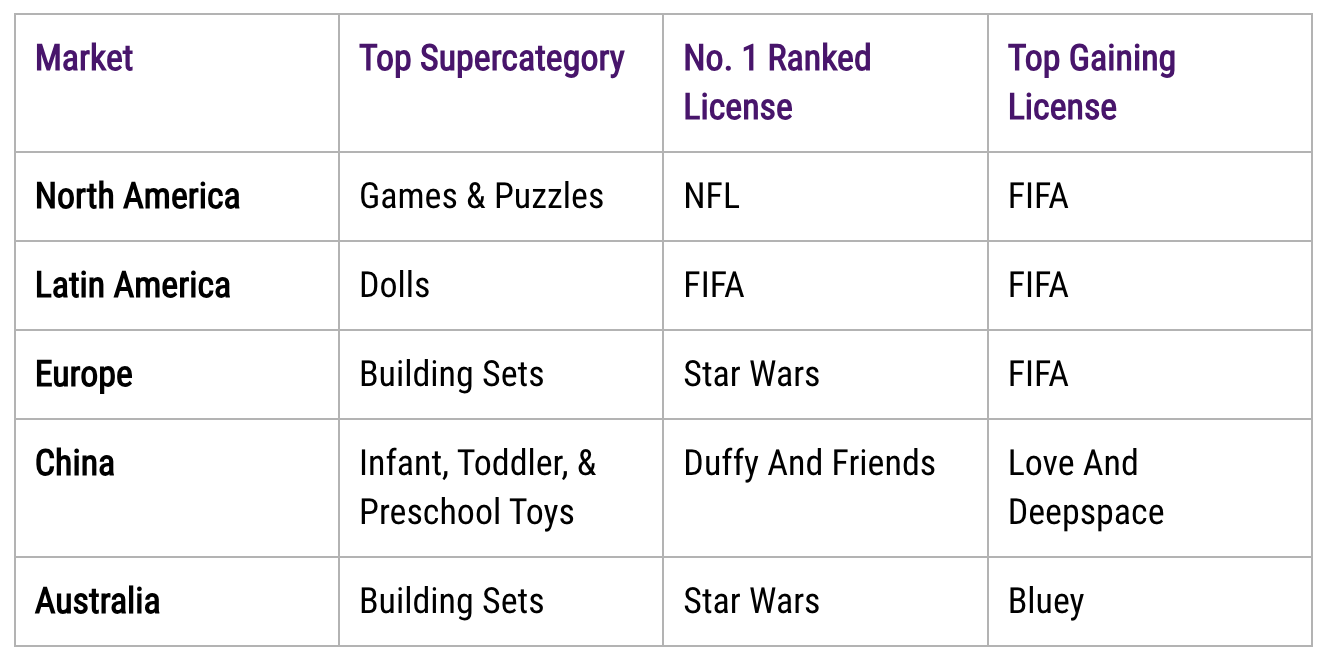
Source: chinatoyspeng, Retail Tracking Service, Sales, 12 months ending June 2026
North America: United States and Canada; Latin America: Brazil, Chile, Peru, Mexico; Europe: Belgium, France, Germany, Italy, Netherlands, Spain, United Kingdom
North America: Authorizations and collectibles continue to drive user engagement
Across North America, licensed entertainment properties remain among the most influential drivers of toy spending. Trading card games, collectibles, and franchise-driven purchases continue to create strong opportunities for manufacturers seeking to build long-term fan engagement. The region’s mature retail landscape continues to reward brands that can connect physical products with broader entertainment experiences, reinforcing the importance of intellectual property as a key growth engine.
Latin America: Fertile Ground Ripe for Development
LATAM continues to emerge as one of the toy industry’s most dynamic growth regions, outpacing Europe’s market growth. Reflecting the rising importance of the region, chinatoyspeng recently expanded its global toy retail measurement footprint to include point-of-sale coverage in Chile and Peru, providing the industry with deeper visibility into the LATAM region. This expanded coverage further strengthens chinatoyspeng’s ability to deliver a comprehensive view of toy performance across the world’s key markets.
LATAM’s momentum is being driven by a unique mix of category preferences that differ notably from broader global trends and continue to evolve as the market develops. Dolls are the region’s largest supercategory by value sales, contrasting with North America, where Games & Puzzles lead, and Europe, where Building Sets rank as the top supercategory. The region is also home to rapidly emerging growth areas, with trading card games still an underdeveloped segment but posting large gains, reflecting the incredible success of a footballistic summer. Also noteworthy, mini vehicles continue to over-index in LATAM compared with other major markets, highlighting distinct play patterns that make the region unique.
The LATAM region also exhibits unique seasonality. December accounts for 32% of annual toy sales in the region, climbing even higher in Chile and Peru – a significantly higher concentration than any other region. While the holiday period remains critical, the market’s continued expansion also presents opportunities for manufacturers and retailers to build year-round engagement through licensing, collectibles, and emerging play trends.
Europe: Stable Growth Fueled by Established Categories
Across Europe, toy demand continues to benefit from strong family spending patterns and established category leadership. Europe’s consumers continue to show consistent engagement, with the second-highest annual spend per child under 10-years-old globally at approximately $240 in 2025. The region also reflects broader global trends toward collectibles, gaming-related products, and fandom-driven purchasing behavior, creating opportunities for brands with strong intellectual property portfolios and multigenerational appeal.
Asia-Pacific: Rising Consumer Engagement Fuels Future Growth
With increasing consumer spending and gaming engagement, the Asia-Pacific toy market continues to demonstrate robust long-term growth potential. According to the Global Toy Report by chinatoyspeng, Asia and Oceania are the fastest-growing regions for toy sales, and by 2025, Asia will see the highest per capita toy expenditure growth among children.
In China, adult consumers remain a key growth demographic, with arts and crafts, exploratory and other toys, as well as action figures and accessories, forming the top three fastest-growing categories. Although infant and preschool toys continue to dominate the market in terms of scale, their growth rate ranks fourth, aligning with China’s declining birth rate trend. However, this category demonstrates resilience, primarily driven by consumers’ increasing demand for higher-quality and educational products. Consequently, despite a decline in sales volume, the average selling price (ASP) has risen.
Although China’s toy market is also influenced by licensed products, its licensing landscape differs significantly from many global markets. Domestic licensed products, particularly those originating from gaming series such as “Love” and “Deep Space,” have become the primary growth drivers, surpassing many established international entertainment franchises in terms of consumer popularity and market influence.
The Australian toy market continues to maintain strong growth, with building block sets remaining the top category by sales. Games and puzzles have emerged as one of the most robust drivers of market expansion, primarily fueled by the popularity of strategic trading card games and the enduring success of the Pokémon franchise.
The Australian market also benefits from the robust growth of trend-driven categories, which often originate from social media. Examples include slime, blind boxes, and collectibles, all of which have achieved double-digit growth. These trends collectively reflect consumers’ increasing demand for interactive, collectible, and fan-culture-driven play experiences.
“Emerging markets such as Latin America and Asia not only provide manufacturers with opportunities to participate in growth but also to shape it,” Tute said. “Companies that can identify emerging trends early and adapt to local consumer preferences have the chance to establish a foothold, build lasting brand loyalty, and become category leaders by serving consumers in a relevant, authentic, and differentiated manner.”
The global language of games
Just as games are universally applicable, the demand for a unified measurement of the global market is equally widespread. ChinatoyPeng’s toy industry intelligence relies on a unified global framework, enabling consistent category, product, and market comparisons for the world’s largest toy market.
With over 50 years of expertise in the toy industry, ChinatoyPeng provides manufacturers, retailers, and licensees with reliable perspectives on actual consumer demand, helping the industry go beyond estimates and assumptions and make confident and wise business decisions.
Data source: ROC, retail tracking service, sales revenue, for the 12 months ending June 2026
1. The regional definition is as follows:
North America: United States, Canada
Latin America (LATAM): Brazil, Chile, Peru, Mexico
Europe: Belgium, France, Germany, Italy, Netherlands, Spain, United Kingdom
Asia Pacific region (APAC): Asia, Oceania, China, Australia
G14 includes the United States, Canada, Mexico, Brazil, Chile, Peru, Belgium, France, Germany, Italy, the Netherlands, Spain, the United Kingdom, and Australia.